Kinsey
Institute Bibliography
Information Services
Prevalence of Homosexuality
Brief Summary of U.S. Studies
This summary sheet is not intended to be a comparative analysis or recommendation
of the studies referenced. Its purpose is to respond to inquiries received
by the Institute by indicating the range of findings in the research literature,
beginning with Alfred Kinsey's two studies, often referred to together
as the Kinsey Reports.
Studies often differ sharply in: 1) definitions; 2) methodology; 3) response
rates. The majority are based on nonrandom samples. Some look at current/previous
year behavior only and others at extended time periods in respondents'
lives. They are listed in chronological order.
Contents
Kinsey's samples are best for younger adults, particularly the college-educated;
they are poorest for minorities and those from lower socioeconomic and
educational levels. The original male sample included institutionalized
men. Paul Gebhard (Gebhard 1979), a Kinsey
research associate and later director of the Institute, described Kinsey's
sampling method as "quota sampling accompanied by opportunistic collection"
(p. 26). Kinsey's data came from in-depth, face-to-face interviews (with
5300 white males and 5940 white females providing almost all of the data).
Sexual Behavior in the Human Male (1948)
and Sexual Behavior in the Human Female (1953)
reported that:
- 37% of males and 13% of females had at least some overt homosexual
experience to orgasm;
- 10% of males were more or less exclusively homosexual and 8% of males
were exclusively homosexual for at least three years between the ages
of 16 and 55. For females, Kinsey reported a range of 2-6% for more
or less exclusively homosexual experience/response.
- 4% of males and 1-3% of females had been exclusively homosexual after
the onset of adolescence up to the time of the interview.
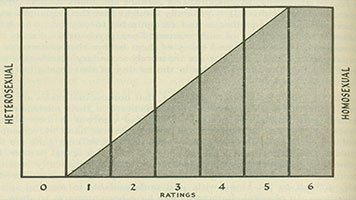
- Kinsey devised a classification scheme to measure sexual orientation.
It is commonly known as the Kinsey
Scale
Reanalyses of Alfred Kinsey's Data
In the Final Report and Background Papers of the National Institute
of Mental Health's Task Force on Homosexuality (Gebhard
1972), Gebhard reanalyzed Kinsey's data to eliminate sample bias.
His refined figures showed that between one-quarter and one-third of adult
white males with college education had had an "overt homosexual experience
since puberty" (mostly in the adolescent years); weighting by marital
status, he estimated that 4% of the white college-educated males and between
1-2% (and closer to 1%) of white females were predominantly or exclusively
homosexual.
In The Kinsey Data, Gebhard and Johnson
(1979) reexamined the amount of homosexual experience in Kinsey's
basic sample of noninstitutionalized males and females. They found 9.9%
of the males in the College Sample had extensive homosexual experience.
3.7% of females had extensive homosexual experience.
Tabulations by Gebhard (McWhirter 1990)
on Kinsey's basic sample of noninstitutionalized males and females indicated
that "13.95% of males and 4.25% of females, or a combined average
of 9.13%" had had either "extensive" or "more than
incidental" homosexual experience. These figures were not weighted
by marital status.
John Gagnon and William Simon (1973) also reanalyzed
Kinsey's data, focusing on the college sample. In their tabulations, 30%
of males reported a homosexual experience to orgasm for the male or his
partner; of this group, 25% had the experience(s) as adolescents or had
only isolated experiences before the age of 20. The remaining 5-6% broke
down evenly, with 3% having had "substantial homosexual histories"
and 3% having had "exclusively homosexual histories." The comparable
figure for females having had a homosexual experience was 6%. Of these,
4% had experience limited to adolescence or scattered experience before
the age of 20, leaving 2% with significant adult homosexual experience,
and less than 1% with exclusively homosexual histories.
Hunt's survey of sexual behavior in the 1970s indicated that 7% of males
and 3% of females had homosexual experiences during more than three years
of their lives. In comparing his data to Kinsey's, Hunt adjusted Kinsey's
37% figure (for males having had some same-sex contact to orgasm) to 25%
and Kinsey's 4% exclusive-homosexuality figure for males to 2-3%. He considered
less than 1% of females as "mainly to completely homosexual."
This was a volunteer survey of 2036 people using questionnaires.
Pietropinto and Simenauer conducted a large-scale survey of 4066 men
in which they asked: "With what type of partner do you usually engage
in sex?" 1.3% responded "with men only"; 3.1% responded
"men and women." Field agents used a self-administered written
questionnaire; participants were recruited at shopping centers, office
buildings, sports clubs, colleges, airports, and bus depots.
Comparing national sample surveys from 1970 Kinsey-NORC data and 1988
National Opinion Research Center (NORC) interviews for males, the authors
gave an estimated minimum prevalence of 20.3% of adult males having had
a homosexual experience to orgasm, with 3.3% of adult men reporting having
had homosexual sex "occasionally" or "fairly often"
at some point in their adult lives (at age 20 or later).
Harry's telephone survey was based on a national probability sample of
663 males. The survey included a question about sexual attraction to members
of the same sex. In the weighted data, 3.7% gave their orientation as
bisexual or homosexual.
Tom Smith looked at the sexual behavior data from the 1988 and 1989 National
Opinion Research Center's (NORC) General Social Surveys, and classified
5-6% of adults as homosexual or bisexual since age 18 (with the percentage
for exclusive homosexuality as less than 1%). The GSS is a probability
sample of approximately 1500 people, and nationally representative; the
results are based on a one-page self-administered questionnaire on sexual
behavior in the last year and since age 18. [Smith has issued a 1998 report
of American Sexual Behavior: Trends, Socio-Demographic Differences,
and Risk Behavior. He discusses some demographic issues surrounding
prevalence of homosexuality. It can be found, in pdf format, from NORC
at http://www.norc.uchicago.edu/online/sex.pdf
Janus and Janus, in their cross-sectional (not random) nationwide survey
of American adults aged 18 and over, stated that 9% of men and 5% of women
reported having had homosexual experiences "frequently" or "ongoing."
In another measure, 4% of men and 2% of women self-identified as homosexual.
The authors used a questionnaire, supplemented by 125 interviews (4,550
questionnaires were distributed, 3,260 were returned, and 2,765 were usable).
A national survey of 3321 men was conducted in 1991 by Batelle Human
Affairs Research Center in Seattle, supported by a grant from the National
Institute for Child Health and Human Development, to obtain data on the
number of men engaging in sexual behaviors that put them at risk for AIDS.
It was a national probability sample of 20-39 year-old noninstitutionalized
males. 2% of sexually active men in the survey reported same-gender sexual
activity during the last 10 years, with 1% reporting being "exclusively
homosexual" during this time (p. 52). Participants were interviewed
in person using a standard questionnaire; they also filled out a self-administered
questionnaire.
The Harris Poll published a critique of the Batelle 1% figure, comparing
it with their own data from a 1988 three-national survey of AIDS' risk
behavior conducted for Project Hope's Center for Health Affairs, which
found more than 4% of men aged 16-50 and more than 3% of women in the
same age group reporting a same-sex sexual partner in the previous five
years.
A research team at the University of Chicago headed a project that conducted
interviews in 1992 of a random probability sample of 3,432 men and women
in the U.S. between the ages of 18-59 (National Health and Social Life
Survey). Homosexuality was viewed as a complex of same-gender behavior,
desire, and identity. 9% of men and 4% of women reported having engaged
in at least one same-gender sexual activity since puberty. Given the identity
category choices of heterosexual, homosexual, bisexual, or something else,
2.8% of men and 1.4% of women surveyed reported "some level of homosexual
identity."
Data on the prevalence of homosexual behavior and the demographic distribution
of homosexual and bisexual men were analyzed from two national probability
surveys (General Social Survey - GSS and the National Health and Social
Life Survey - NHSLS) and a probability survey of urban centers in the
U.S. (National AIDS Behavioral Surveys - NABS) and results from earlier
surveys discussed. Combined data from the GSS and NHSLS surveys showed
5.3% of men reporting sexual activity with a same-gender partner since
age 18. Data from the NABS showed 6.5% of men reporting sex with men during
the previous five years. The highest prevalence was found in central cities
of the 12 largest SMSAs (14.4% since age 18) and among "highly educated"
White males (10.8%).
A later article on the Hope/Harris survey by Sell reported data on both
homosexual attraction as well as homosexual behavior. The figures reported
were: 6.2% of U.S. males and 3.6% of U.S. females with "sexual contact
with someone of the same sex only or with both sexes in the previous five
years," and 20.8% of U.S. males and 17.8% of U.S. females with some
homosexual behavior or some homosexual attraction since age 15. The percentage
of respondents reporting sexual contact only with others of the same sex
in the previous five years in the U.S. was below 1%.
A stratified random sample of males in Calgary, Canada (a metropolitan
region of .78 million) was questioned using a computerized response format
and three measures of homosexuality. Based on one or more of the overlapping
measures, 15.3% of males reported being homosexual to some degree.
In a national survey, 90% of men aged 18-44 considered themselves to be heterosexual, 2.3% as homosexual, 1.8% as bisexual, and 3.9% as 'something else.' Among women aged 18-44 in the same survey, 90% said they were heterosexual, 1.3% homosexual, 2.8% bisexual, and 3.8% as 'something else.'
While about 7% of adult women and 8% of men identify as gay, lesbian or bisexual, the proportion of individuals in the U.S. who have had same-gender sexual interactions at some point in their lives is higher.
Data collected from a national sample of 13,495 men and women between 2006 and 2008. The study attempted to differentiate between sexual attraction, sexual behavior, and sexual identity. The percentage reporting their sexual identity as homosexual ranged from 2% to 4% of males, and about 1% to 2% of females. The percentage reporting their sexual identity as bisexual is between 1% and 3% of males, and 2% to 5% of females. About 4%–6% of males ever had same-sex contact. For females, the percentage who have ever had same-sex contact ranges from about 4% in the GSS, to 11%–12% in the 2002 and 2006–2008 NSFG.
While researchers at the National Academy of Sciences' National Research
Council, Committee on AIDS Research and the Behavioral, Social, and Statistical
Sciences, Rogers and Turner analyzed estimates from five probability surveys,
1970 to 1990. They gave estimated minimums of 5-7% for males having experienced
some same-sex sexual contact in adulthood.
Diamond looked at studies done on the prevalence of homosexual behavior.
He included some studies done on populations outside the U.S. The date
ranges varied from country to country, but spanned 1948 to 1991. Those
studies discussed were compared and displayed in tablular form. He found
the mean of males surveyed to be 5.5% of the population, and the median
to be 5.3%. The mean of females that engaged in same sex behavior was
2.5% and the median was 3.0%. The calculations were of all non-Kinsey
data. Diamond found that methods employed by these studies were inconsistent.
The authors reviewed methods used in defining and measuring sexual orientation,
and briefly critiqued surveys of homosexual activity from Kinsey in 1948
to the 1994 study by Laumann, et al. Because of the possible risks involved
in self-disclosure, it is posited that the recurrent 2-5% for same-gender
sexual behavior in the studies reviewed represents a minimum figure. They
suggest that the current prevalence of predominant same-sex orientation
is 4-17%.
Hewitt analyzed past surveys on the prevalence of homosexuality in the
United States, from 1970 to 1994, looking critically at the methodology
of these studies. He offered a metanalysis of the typologies used in these
surveys to classify the homosexual. He found five types: (1) open preferential
homosexuals, (2) repressed preferential homosexuals, (3) bisexuals, (4)
experimental homosexuals, and (5) situational homosexuals.
Gates analyzed information from four recent national and two state-level population-based surveys. The analyses suggest that there are more than 8 million adults in the US who are lesbian, gay, or bisexual, comprising 3.5% of the adult population. He estimated an additional 700,000 individuals identified as transgender.
Revised: 4/11
Bagley, C., and Tremblay, P. (1998).
On the prevalence of homosexuality and bisexuality, in a random community
survey of 750 men aged 18 to 27. Journal of Homosexuality 36(2),
1-18.
Billy, J., Tanfer, K., Grady, W., and Klepinger,
D. (1993). The sexual behavior of men in the United States. Family
Planning Perspectives 25(2), 52-60.
Binson, D., Michaels, S., Stall, R., Coates,
T.J., Gagnon, J.H., and Catania, J.A. (1995). Prevalence and social
distribution of men who have sex with men: United States and its urban
centers. Journal of Sex Research 32(3), 245-254.
Chandra A, Mosher WD, Copen C, Sionean C. (2011)Sexual behavior, sexual attraction, and sexual identity in the United States: Data from the 2006–2008 National Survey of Family Growth. National health statistics reports; no 36. Hyattsville, MD: National Center for Health Statistics.
Diamond, M. (1993). Homosexuality and bisexuality
in different populations. Archives of Sexual Behavior 22(4), 291-310.
Fay, R., Turner, C., Klassen, A., and Gagnon, J. (January
1989). Prevalence and patterns of same-gender sexual contact among men.
Science 243, 338-348.
Gagnon, J., and Simon, W. (1973). Sexual Conduct:
The Social Sources of Human Sexuality. Chicago: Aldine.
Gates, G. J. (2011).
How many people are lesbian, gay, bisexual, and transgender? Los Angeles, CA: The Williams Institute, UCLA School of Law.
Gebhard, P. H. (1972). Incidence of overt homosexuality
in the United States and Western Europe. In
National Institute of Mental
Health Task Force on Homosexuality: Final Report and Background Papers,
edited by J. M. Livingood. Rockville, MD: National Institute of Mental Health.
Gebhard, P.H., and Johnson, A.B. (1979). The
Kinsey Data: Marginal Tabulations of 1938-1963 Interviews Conducted by the
Institute for Sex Research. Philadelphia: W.B. Saunders.
Gonsiorek, J.C., Sell, R.L., and Weinrich, J.D.
(1995). Definition and measurement of sexual orientation. Suicide and
Life-Threatening Behavior 25(Supplement), 40-51.
Harry, J. (1990). A probability sample of gay males.
Journal of Homosexuality 19(1), 89-104.
Hewitt, C. (1998).Homosexual demography: implications
for the spread of AIDS.
Journal of Sex Research 35(4), 390-397.
Hunt, M. (1974). Sexual Behavior in the 1970's.
New York: Dell.
Janus, S., and Janus, C. (1993). The Janus Report
on Sexual Behavior. New York: John Wiley & Sons.
Kinsey, A., Pomeroy, W., and Martin, C. (1948).
Sexual Behavior in the Human Male. Philadelphia: W.B. Saunders.
Kinsey, A., Pomeroy, W., Martin, C., and Gebhard, P.
(1953). Sexual Behavior in the Human Female. Philadelphia:
W.B. Saunders.
Laumann, E., Gagnon, J.H., Michael, R.T., and Michaels,
S. (1994). The Social Organization of Sexuality: Sexual Practices
in the United States. Chicago: University of Chicago Press.
McWhirter, D., Sanders, S., and Reinisch, J. (Eds.).
(1990). Homosexuality/Heterosexuality. The Kinsey Institute
Series. New York: Oxford University Press. [Includes 1977 Gebhard letter
to National Gay Task Force on tabulations of Kinsey's data.]
Mosher WD, Chandra A, Jones J. Sexual behavior and selected health measures: Men and women 15–44 years of age, United States, 2002.
Advance data from vital and health statistics; no 362. Hyattsville, MD: National Center for Health Statistics. 2005.
National Survey of Sexual Health and Behavior (NSSHB). Findings from the National Survey of Sexual Health and Behavior, Centre for Sexual Health Promotion, Indiana University.
Journal of Sexual Medicine, Vol. 7, Supplement 5.
Pietropinto, A., and Simenauer, J. (1977). Beyond
the Male Myth. New York: Times Books.
Rogers, S., and Turner, C. (1991). Male-male sexual
contact in the U.S.A.: Findings from five sample surveys, 1970-1990.
Journal
of Sex Research 28(4):491-519.
Sell, R. L., Wells, J. A., and Wypij, D. (1995).
The prevalence of homosexual behavior and attraction in the United States,
the United Kingdom and France: Results of national population-based samples.
Archives of Sexual Behavior 24(3), 235-248.
Smith, T.W. (1991). Adult sexual behavior in 1989:
Number of partners, frequency of intercourse and risk of AIDS.
Family
Planning Perspectives 23(3), 102-107.
Taylor, H. (1993). Number of gay men more than
four times higher than the 1 percent reported in a recent survey.
The
Harris Poll #20. New York, NY: Louis Harris & Associates.
Wells, J.A., and Sell, R.L. (1990). Project
Hope's International Survey of AIDS Educational Messages and Behavior Change:
France, the United Kingdom, and the United States. Bethesda, MD: Project
Hope, Center for Health Affairs.